Three things to know before selling luxury brand items
People selling luxury brand items for the first time most often run into three problems: they did not bring proof of identity, they left the accessories at home, or they were unsure which appraisal method to choose. In this article, staff who carry out appraisals at our two shops (Diamond Seven Shinsaibashi and Luxury Seven) focus on these three points and explain the process from preparing to sell through to receiving payment.
The legal explanations in this article are based on primary information from the relevant government authorities and the official law database. For specific practices, such as the types of documents we accept, please contact each shop before your visit.
Why is proof of identity required? (Secondhand Articles Dealer Act)
Luxury brand buyers operate under a "secondhand dealer" license granted under the Secondhand Articles Dealer Act (古物営業法). Under this Act, when a secondhand dealer buys an item, the dealer is required to verify the seller's address, name, occupation and age (Article 15 of the Secondhand Articles Dealer Act). This system is intended to prevent stolen goods from circulating and to help victims recover their property if stolen goods are found.
Under the law, there is an exception under which verification is not required for transactions with a total price of less than ¥10,000, but certain categories such as video game software and books require verification regardless of the amount. In addition, most luxury brand transactions are ¥10,000 or more, and it is common for shops to verify identity as a matter of policy regardless of the amount.
Key point
Secondhand dealer licenses are issued by the Public Safety Commission of each prefecture. Checking whether a shop's website or storefront displays a notice such as "Secondhand dealer license No. XX (XX Prefectural Public Safety Commission)" can help you judge whether the shop is licensed. An overview of the system is available on the website of the National Police Agency.
Which documents should I bring?
As a rule, proof of identity should be an official document showing your name, address and date of birth. Please bring the original when you visit.
| Document | Points to note |
|---|---|
| Driver's license | Must be within its validity period. If you have changed your address, the back of the license will also be checked |
| My Number Card | Only the front is used for verification. Your Individual Number (on the back) will not be recorded |
| Passport | If it has no field for your address, you may be asked to show an additional document that confirms your address |
| Residence card, etc. | Must be within its validity period |
| Other documents | Types of documents we accept: [To be confirmed] |
For transactions not conducted in person, such as buying by mail, you send a copy of your proof of identity, and verification is also carried out by a method set out in the law (such as restricted-delivery mail that can only be received by the addressee in person). Our specific procedure is [To be confirmed].
How do accessories affect the appraisal?
When appraising luxury brand items, we check whether accessories are included as well as the condition of the item itself. We classify accessories into three categories: "full set," "partial set" and "item only" (see Price Data and Editorial Policy for definitions).
| Category | Main accessories |
|---|---|
| Bags (Hermès, Chanel, etc.) | Box, dust bag, guarantee card, key and cadena (padlock), rain cover, original purchase receipt |
| Watches (Rolex, etc.) | Box, warranty card (guarantee card), spare links, instruction manual, tags |
| Jewelry (Cartier, etc.) | Box, warranty card, grading report / identification report, dedicated screwdriver (for the Love Bracelet, etc.) |
| Silver (Chrome Hearts, etc.) | Original purchase receipt or invoice, dust bag |
Items without accessories can often still be bought, so there is no need to give up on selling just because you cannot find them. Please bring whatever accessories you do find. Details for each category are explained on the Watches, Jewelry and Silver pages.
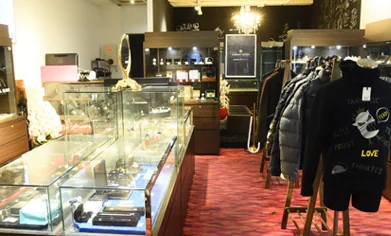
From appraisal to payment
This is the process for in-store buying at our shops. The appraisal itself is largely the same for buying by mail and LINE photo appraisal. There are no appraisal or handling fees, and you are welcome to visit for an appraisal only.
- ReceptionShow us the items you wish to sell and your proof of identity.
- AppraisalWe check the brand, model number, condition and accessories, and authenticate the item. The time required depends on the number and type of items.
- OfferWe present our offer and explain the basis for it (condition, accessories, the market price at the time of appraisal, etc.). If you are not satisfied, you may take your items home without selling.
- Contract and identity verificationOnce you agree to sell, we verify your identity and you fill in the required forms.
- PaymentAt Luxury Seven, we pay in cash on the spot. The payment method at Diamond Seven Shinsaibashi is [To be confirmed].

How do in-store buying, buying by mail and LINE photo appraisal differ?
| Item | In-store buying | Buying by mail | LINE photo appraisal |
|---|---|---|---|
| How the appraisal works | We appraise the item in person at the shop | You send the item and we appraise it at the shop | You receive an estimate based on photos and messages |
| Identity verification | Show the original document at the shop | A method in line with the law, such as sending a copy of the document | Carried out in store or by mail when you sell |
| Receiving payment | Often paid on the spot | Usually by bank transfer after appraisal and your acceptance | Estimate only; sell in store or by mail |
| Suited to | Those who want cash quickly or prefer to hear the explanation in person | Those who have no time to visit or live far away | Those still deciding whether to sell or wanting only a rough figure |
| Points to note | Check opening hours in advance | Take care to avoid damage during packing and shipping | The amount may change after the item is examined in person |
Both of our shops, Diamond Seven Shinsaibashi and Luxury Seven, offer in-store buying, buying by mail and LINE photo appraisal. For help choosing between the two shops, see Choosing Between Diamond Seven and Luxury Seven.
ブランドバッグの査定は当店へ(電話・LINEで無料相談)
どちらの店舗でも査定・ご相談を承ります。2店舗の違いと選び方
Can minors sell luxury brand items?
Since April 2022, the age of majority in Japan has been 18. In principle, a sales contract concluded by a minor under 18 without the consent of a legal representative such as a parent can be rescinded (Article 5 of the Civil Code (民法)). For this reason, buyers generally either do not accept items from people under 18 or require a written consent form from a parent or guardian, or for the parent or guardian to be present.
In addition, prefectural youth protection ordinances may contain provisions on buying secondhand articles. How this applies in Osaka Prefecture and our conditions for accepting items are [To be confirmed]. Shops may also ask 18- and 19-year-olds for additional verification.
Note
Please be sure to contact us before your visit regarding the format of the parental consent form and whether a parent or guardian must accompany you.
Checking market prices before you sell
For a guide to what you might be offered, you can check our past buying records in the Price Tracker. Market prices vary with condition, accessories and timing, so please treat them as a guide only. Representative price pages include Hermès Birkin 30, Chanel Matelassé 25 and Cartier Love Bracelet.
If you are unsure whether to sell or to raise money while keeping the item, see also Pawn Loans vs. Selling. If you wish to sell late at night, points to note are summarized in How to Sell Late at Night.
FAQ
Can I sell with a copy of my proof of identity?
In store, you are generally asked to show the original. For buying by mail, you can send a copy of the document, but additional verification set out in the law will be carried out.
Can I sell an item on behalf of a family member?
Identity verification is carried out for the person actually selling. How we handle selling an item on behalf of a family member is [To be confirmed]. Please contact the shop in advance.
What happens if I am not satisfied with the offer?
You are under no obligation to sell after an appraisal. In store, you may take your items home. How return shipping costs are handled for buying by mail is [To be confirmed].
Will you buy items without accessories?
In many cases, the item alone can still be appraised. Whether accessories are included may affect the offer, so please bring any you find.
Am I guaranteed to be able to sell at the LINE photo appraisal price?
A LINE photo appraisal is an estimate based on photos. After we examine the item in person, the amount may change depending on its condition and accessories.
Sources and references
- National Police Agency (overview of the secondhand business system) (accessed Sep 28, 2026)
- e-Gov Law Search: "Secondhand Articles Dealer Act" and "Ordinance for Enforcement of the Secondhand Articles Dealer Act" (accessed Sep 28, 2026)
- e-Gov Law Search: "Civil Code" (Articles 4 and 5) (accessed Sep 28, 2026)
- Osaka Prefecture Ordinance on the Healthy Development of Young People [To be confirmed: URL]